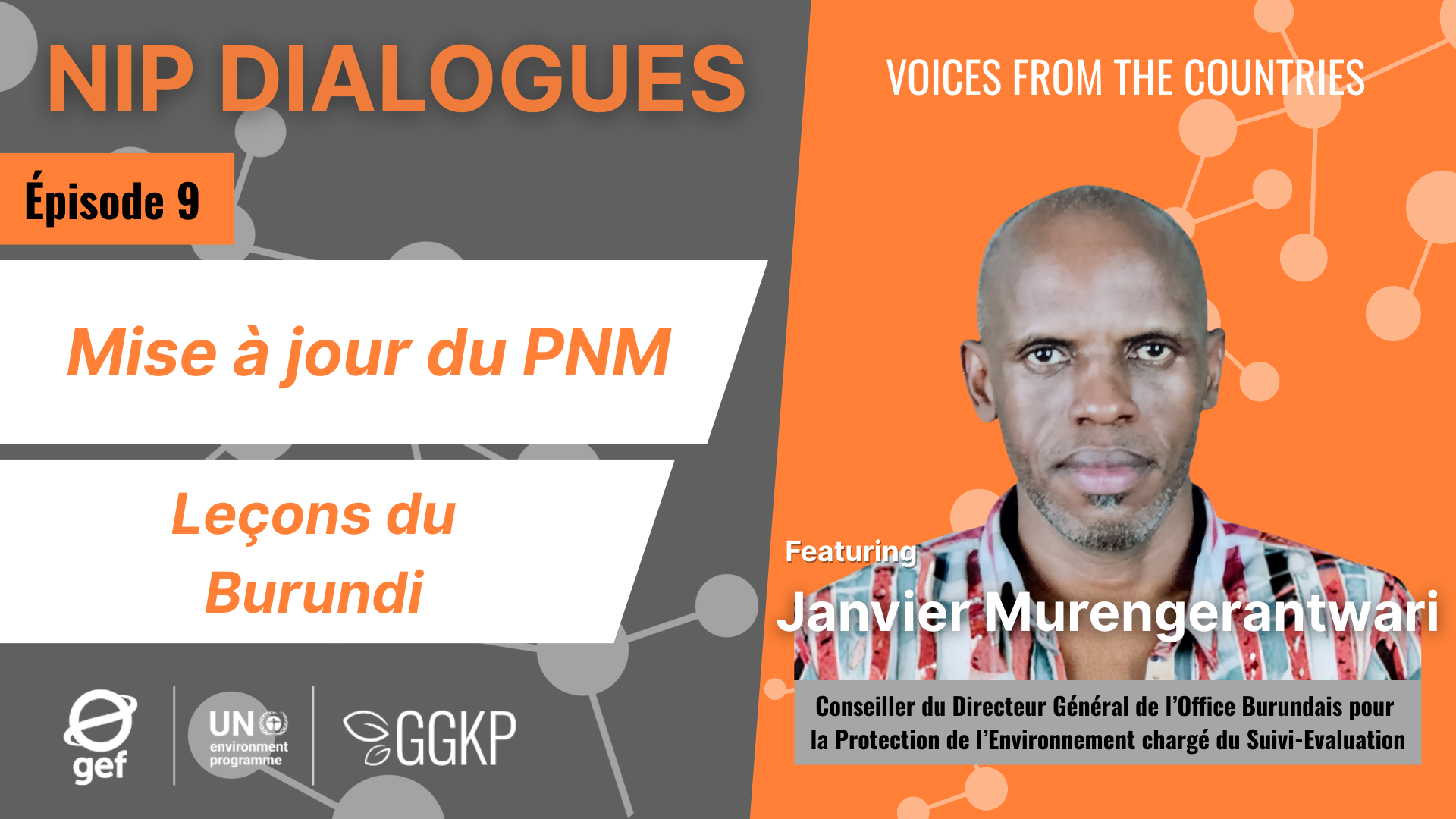


NIP Dialogue Series – Voices from the Countries
Bujumbura, Burundi – January 2026
This blog post draws on an interview with Janvier Murengerantwari, Advisor for Monitoring and Evaluation at the Directorate General of the Burundian Office for the Protection of the Environment (OBPE). The interview is part of the NIP Dialogues Series under the Global NIP Update project (GEF ID 10785), funded by GEF and led by UNEP.
Burundi is currently developing its third National Implementation Plan (NIP) under the Stockholm Convention on Persistent Organic Pollutants (POPs), marking an important milestone. Following its first NIP in 2006 and a second in 2017, the current update – supported by the United Nations Environment Programme (UNEP) – expands the scope to include POPs listed up to the ninth Conference of the Parties (COP9).
Janvier Murengerantwari, Advisor for Monitoring and Evaluation at the Directorate General of the Burundian Office for the Protection of the Environment (OBPE) and Stockholm Convention National Focal Point since 2019, shared Burundi’s journey to improve data quality, continuity and accessibility, strengthen institutions and treat POPs management as a sustained national commitment.
Expanding the POPs baseline
One of the most significant changes in the current NIP update is the availability of new data compared to previous inventories. Earlier NIP processes could not identify certain POPs, leaving them effectively invisible to policy and management efforts. The current work incorporates POPs not previously considered, including pentachlorobenzene (PeCB), and gives greater attention to unintentional POPs (UPOPs). Using UNEP toolkits, the team has moved beyond the earlier focus on dioxins and furans to account for a wider range of UPOPs in the updated NIP.
National coordination at the core of the NIP update
Burundi’s current NIP update is being steered through a formal national coordination mechanism (NCM) that brings together representatives of all key institutions involved in POPs management. This body reports to the Ministry of Environment, which is responsible for the NIP update and supervises the institution designated to lead it – currently the OBPE.
Acting as a steering structure, the NCM coordinates all NIP-related activities. Once established, the mechanism identified institutional experts working on POPs and formed a group of national specialists, competitively recruited from research institutions to support data collection process. Currently, three university professors play a central role in compiling inventories and gathering data in Burundi.
Continuity through research institutions
This structure reflects lessons from earlier approaches, where data collection relied on individual ministry experts and continuity was weak. Much of that work had depended on government officials who have since retired, taking their knowledge and data with them.
The current approach intentionally centres research institutions and young researchers to prevent the loss of institutional memory seen in earlier NIP cycles. By working with academics who supervise students and maintain long‑term research agendas, Burundi aims to build a stronger foundation for future NIP implementation. The University of Burundi is a key partner, particularly the Departments of Chemistry and Bioengineering in the Faculty of Sciences.
These institutions are expected not only to support the present update, but also to serve as long‑term repositories and generators of knowledge on POPs in Burundi. This strategic alignment between environmental administration and academia is presented as a practical way to ensure that data and expertise are preserved beyond government staff turnover.
Unlocking access to POPs data
Another distinctive feature of Burundi’s current NIP update is its structured approach to data access. After identifying relevant institutions, national experts mapped out the types of POPs data present in Burundi and requested formal access through letters endorsed by the environment minister. The aim was to open doors, ensure data accessibility and reinforce that sharing information supports the common goal of protecting human health and the environment.
This approach has produced tangible results. Institutions that were previously difficult to reach, including defense and police services, have become more cooperative as awareness has grown, providing data that were not available during earlier NIP cycles. As a result, POPs not previously detected or documented are now supported by strong evidence. The outcome is a more accurate and comprehensive picture of POPs in Burundi, enabling better-informed decision‑making.
Addressing the PCB challenge
Within Burundi’s current NIP update, polychlorinated biphenyls (PCBs) stand out as a clear priority. Expired pesticides in storage are also recognized as an issue, but they do not pose the same level of concern.
PCBs are described as “really present” and a concrete reality in Burundi, with large quantities still in use or held in stockpiles. The country has never had a dedicated plan to eliminate them, and the current update highlights multiple challenges, including substantial PCB-containing materials and potentially contaminated sites nationwide.
Regulatory framework for POPs
On the governance side, Burundi enacted a Chemicals Management Code three years ago, providing a general framework for chemicals management and explicitly incorporating the Stockholm Convention. POPs listed in the convention’s annexes are automatically reflected in the national code, with the convention's restrictions, exemptions and other obligations mirrored in domestic law.
However, this code is recognized as a general guideline that lacks provisions specific to POPs. The ongoing NIP update, therefore, includes an assessment of institutional and regulatory frameworks for POP management and provides recommendations for more targeted legal and regulatory measures. With the deadline for PCB use approaching, a key recommendation is to develop dedicated legislation on PCBs and a national guidance document, particularly for industry, to enable sound PCB and broader POPs management.
Communication and awareness
Participation and data availability are closely associated with communication and awareness-raising. Before the current revision began, a series of workshops were held to inform a wide range of stakeholders, including civil society, industry, traders, academics and responsible institutions. This broad engagement is credited with helping achieve results that were not possible under the previous NIP, as stakeholders now have a better understanding of the risks and obligations associated with POPs.
Since the 2017 NIP, awareness efforts have included brochures in the national language explaining the harmful effects of POPs. The current revision has brought in government ministries that were not previously involved, notably the Ministry of Public Security, which is responsible for civil protection and manages firefighting foams linked to per- and polyfluoroalkyl substances (PFAS). As a result, the updated NIP now includes data from public safety, civil protection, military and civil aviation.
NIP update as a national commitment
"Always aim for continuity, as this is work that must be done. It is the commitment made by countries under the Stockholm Convention." - Janvier Murengerantwari
Janvier Murengerantwari's key message from Burundi’s experience is the importance of “always aiming for continuity.” He emphasized that NIP updates are part of countries’ ongoing obligations under the Stockholm Convention.
This requires avoiding overreliance on external consultants who may leave with critical data and knowledge once their assignments end. Instead, Burundi’s experience points to the value of working with research institutions and young researchers, integrating them into the process, involving them in data collection and analysis, and raising awareness among industrial producers so that POPs-related data can be systematically collected and retained.
Better POPs management is in the interest of protecting the environment and human health. The goal is not to impose costs on producers, but to ensure that decisions are grounded in reliable information and that long‑term health and environmental protection are at the centre of national policy.
To watch the full interview, please follow this link: https://youtu.be/HnosEniwD1Q
To learn more about the Global NIP Update project, visit Global NIP Update | Green Policy Platform