

Chemicals produced and placed on the market, various chemical-based products, are in everyday use and their advantages and benefits are widespread and recognized. The production of all types of chemicals, from one million tons, as it was 70 years ago, now reaches several hundred million tons a year, and by 2050, their sales at the global level could grow by about 3% annually. The fastest growing industries in the world are the chemical and pharmaceutical industries, with a share of over 10% in the total world economy. With the increase in the use of chemicals in modern life, knowledge about their impact on human health and the environment is growing. Almost 50,000 chemicals placed on the Serbian market annually.
The level of exposure to toxic chemicals, as well as the resulting impact on human health, is determined by biological age and gender (physiological differences between women and men and between adults and children, health status, lifestyle, heredity, etc.) and social factors (profession, gender-specific occupational roles, specific occupational groups such as collectors of secondary raw materials, employees in the recycling industry, etc.), as well as the type and frequency of such exposures. Population groups - children under the age of five, pregnant and breastfeeding women, adults between the ages of 50 and 75 are the most sensitive to environmental risk factors. WHO estimates also indicate that almost a quarter of the global disease burden in 2012 (22% of DALYs and 23% of deaths) could have been prevented by reducing exposure to environmental risk factors, and that eliminating hazards and reducing environmental risks could significantly contribute to the preservation of public health, the achievement of the goals of sustainable development and the deepening of inter-sectoral cooperation.
For these reasons, chemical safety as a prerequisite for chemical security is a global goal, and the improvement of chemical management systems and reduction of chemical exposure are the basis for protecting human health throughout the life cycle and minimizing harmful effects on human health and the environment.
Hazardous waste by its origin, composition or concentration of hazardous substances can impact the environment and human health. Inadequate waste management and waste depositing/disposal in unsanitary landfills and waste dumps can have a significant negative impact on the environment and human health. Waste directly affects air, groundwater and surface water and soil. Urbanization and industrialization, as well as population growth and rising living standards, have contributed to the increase in waste, which is becoming a global problem and one of the priorities to be addressed globally.
By establishing a more rational system, which will simultaneously increase environmental safety and minimize harmful effects on human health, key steps have been taken in terms of strengthening existing and developing new measures to establish a common chemical and waste management policy, further integration of general environmental policy into other sectoral policies and raising the awareness of the professional and general public about the importance of the impact of chemicals and waste on human health and the environment.
National Approach to the Global Solution of Problems Related to the Safe Management of Chemicals and Waste in Serbia
The Republic of Serbia has been an active participant in the realization of activities at the global level in order to improve environmental protection since 1992, when the Rio Declaration on Environment and Development was adopted under the auspices of the United Nations. From that period until today in continuity, significant results have been achieved through the implementation of numerous international conventions and protocols, all with the aim of protecting human health and the environment.
The Republic of Serbia is a member of the following international agreements in the field of chemicals and waste management:
- Basel Convention on the Control of Transboundary Movements of Hazardous Wastes and Their Disposal
- Rotterdam Convention on the Prior Informed Consent Procedure for Certain Hazardous Chemicals and Pesticides in International Trade
- Stockholm Convention on Persistent Organic Pollutants (POPs)
- Minamata Convention on Mercury
In order to achieve common goals, the conferences of the parties to the Basel, Rotterdam and Stockholm (BRS) Conventions have adopted a series of decisions over the years to improve cooperation and coordination between these conventions. In this way, a framework for the so-called "synergy process" was established.
The key benefits of implementing the BRS Convention in achieving the goals of sustainable development and the 2030 Agenda for Sustainable Development are that the implementation of these three conventions at the global, regional and national levels enables the establishment of an integrated system for safe management of hazardous chemicals, products containing hazardous chemicals and hazardous waste through the entire cycle of circulation of these hazardous substances in the environment, such as from production and generation, through the manner of use and treatment when they become waste.
1. Initial synergy step forward to implement of Basel, Rotterdam, Stockholm and Minamata Convention in Serbia – BRS-M focal and contact persons under same roof – Ministry of Environmental Protection
Innovative approaches refer to technological and technical solutions, as well as to the development of institutional and infrastructural capacities, but also to the approach to problem solving itself, with the inclusion of social innovations.
Synergies between multilateral environmental agreements, such as the Basel, Rotterdam, Stockholm and Minamata (BRS-M) Conventions, represent a useful step forward that will help avoid duplication of effort, inefficient use of available resources and management at different levels.
In the synergistic approach to the implementation of these conventions, the Republic of Serbia has many years of positive experience, and the current situation provides a basis for further improvement of the synergy of these conventions:
- The Ministry of Environmental Protection is the competent authority for the Basel, Rotterdam, Stockholm and Minamata Conventions.
- The national focal points (NFPs) for Rotterdam Convention, Stockholm Convention and Global Framework on Chemicals (GFC) are in the Department for Chemicals, while the NFP for Basel Convention is in the Waste Management Department. Both departments are within the same sector for waste and wastewater management and development of circular economy in the Ministry of Environmental Protection.
In this way, cooperation between focal points under same Ministry of Environmental Protection in monitoring the implementation of conventions is facilitated, exchange of experiences and cooperation enables rational use of existing institutional and administrative capacities within the same competent authority.
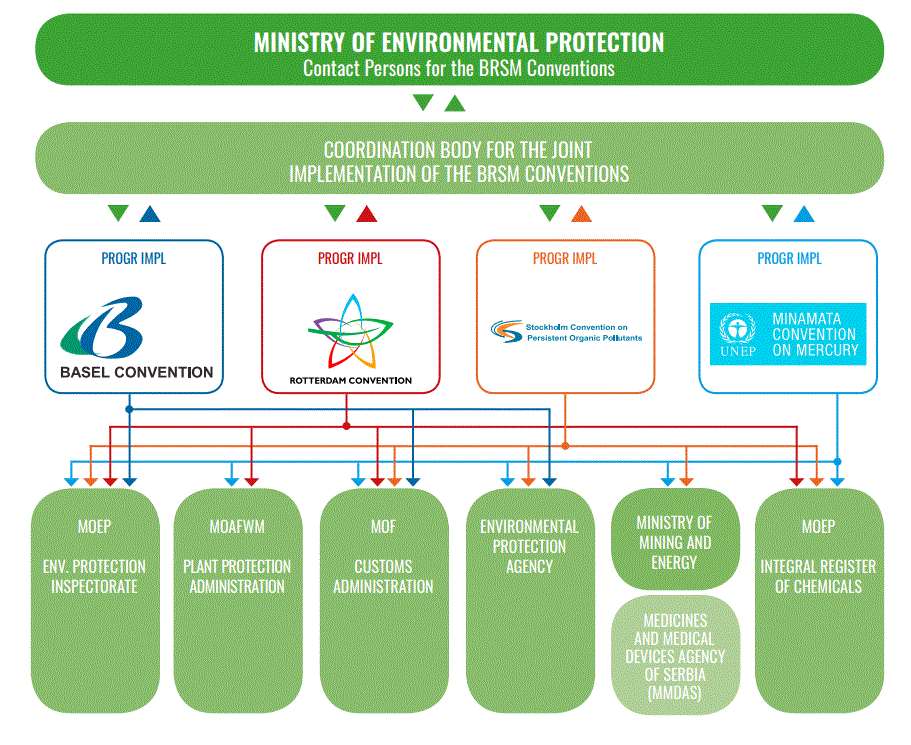
2. Step - Establishment of the BRS-M Conventions National Coordination Working Group
As further step forward in our national BRS-M Conventions synergy approach, National coordination working group established to improve coordination and cooperation with other key national stakeholders in implementation of the Basel, Rotterdam, Stockholm and Minamata Conventions as well as to facilitate collection and processing data for national reporting purposes.
3. Step - Establishment of an efficient information system for data collection and reporting in accordance with the provisions of the Basel, Rotterdam, Stockholm and Minamata Conventions
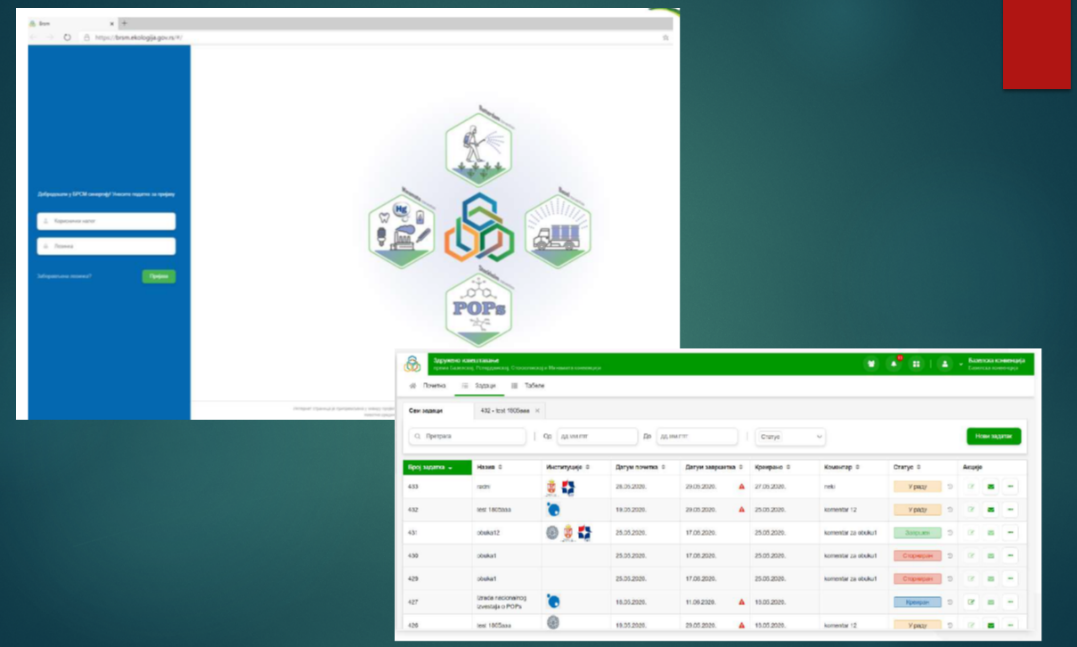
In order to build synergies between the reporting processes under each of four conventions, a Joint Information System established to store and manage data needed for reporting to the BRS-M Conventions and relevant European Union (EU) bodies (e.g. the European Environment Agency, European Chemicals Agency). This system established within the Ministry responsible for environmental protection, being a main coordinating institution for chemicals and wastes management. It enabled synergistic approach to the process of data collection and management for various reporting obligations under the chemicals and wastes cluster (including the Basel, Stockholm, Rotterdam, Minamata Conventions, Convention on Long-range Transboundary Air Pollution).
The IT system also supported timely transmission to the BRS Secretariat of information of relevance to the reporting to the BRS Conventions, including national reports to the Basel and Stockholm Conventions, import responses under Rotterdam Convention, Final Regulatory Actions (FRAs), National Implementation Plan (NIP) updates under the Stockholm Convention. The system also included statistical data on the production, import and export of the chemicals from National Chemicals Register, waste (including information on the quantity/volume and type of wastes generated), System followed and is in compliance with the electronic reporting systems of the Basel and Stockholm Conventions. The IT system acts as supporting tool for NFPs for the conventions to respond to the reporting requirements of each of the convention, namely in the context of data provision and gathering, transparency and compliance with other reporting obligations (to other international agreements and under the EU reporting obligations upon accession of Serbia to the EU membership).
To learn more about the Global NIP Update project, visit Global NIP Update | Green Policy Platform
For a deeper dive into the GGKP round table “National Coordination Mechanisms for Robust NIP Implementation”, you can access the full recordings and materials here: https://www.greenpolicyplatform.org/webinar/national-coordination-mechanisms-robust-nip-implementation