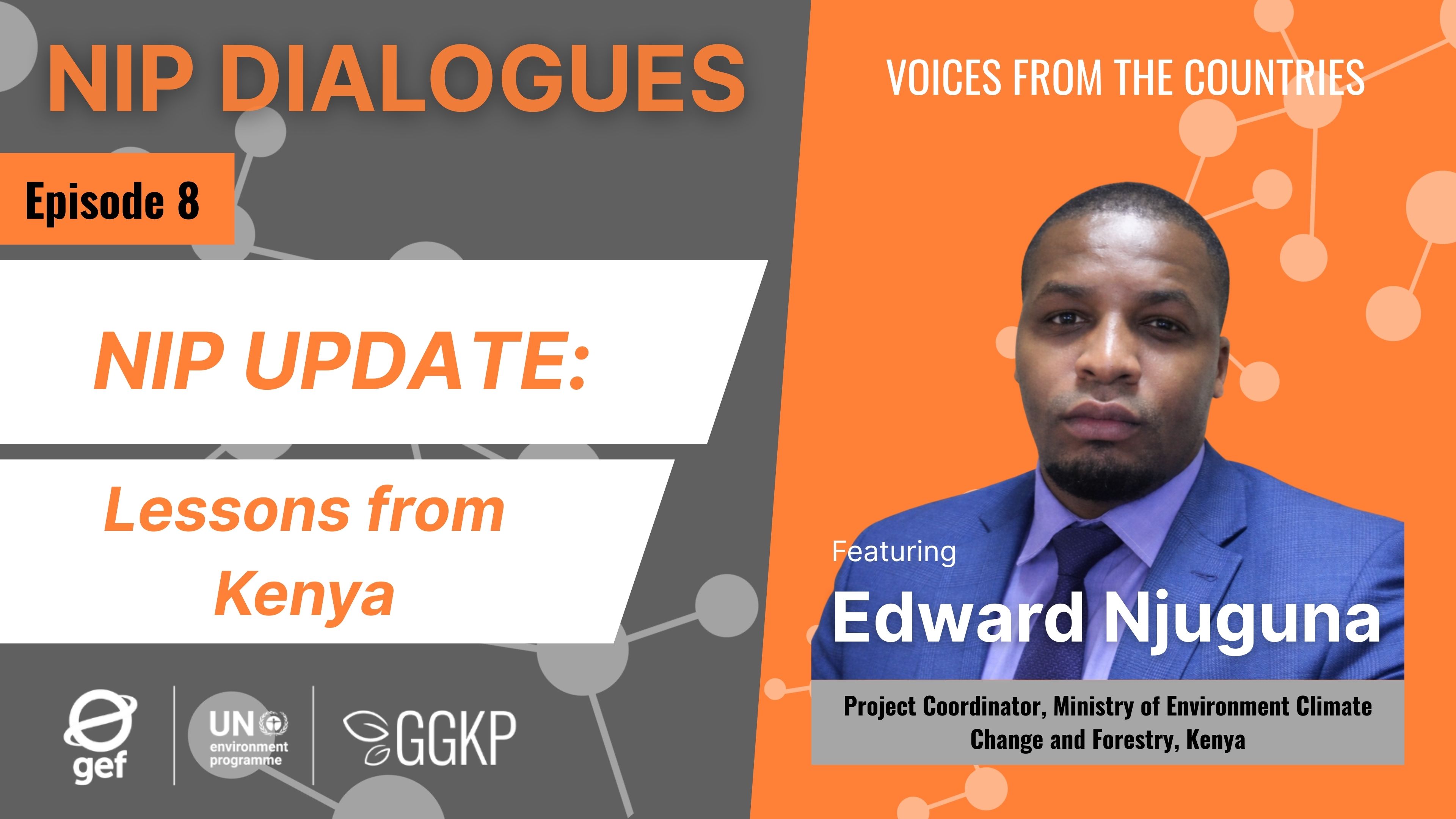


The blog is written following an interview with Mr. Edward Njuguna, Project Coordinator at the Ministry of Environment, Climate Change and Forestry of Kenya, as part of a Series of NIP Dialogues under the Global NIP Update project (GEF ID 10785), funded by GEF and led by UNEP.
Nairobi, Kenya – November 2025
Kenya has officially launched its National Coordination Mechanism (NCM) for the Global NIP Update Project. Its first meeting in November 2025 signals strong momentum and a clear path forward for the National Implementation Plan (NIP) update under the Stockholm Convention on Persistent Organic Pollutants (POPs).
Kenya’s NCM leverages the existing national multisectoral committee on sound chemicals management—established in 2021 under the Strategic Approach to International Chemicals Management (SAICM) project—bringing together diverse stakeholders. Key government institutions include the Ministry of Environment, National Environment Management Authority, Ministry of Health, Pest Control and Pesticide Board, Kenya Revenue Authority and Kenya Bureau of Standards. Academia provides technical expertise, civil society organizations like the Centre for Environment and Development (CEJAD) are engaged, and industry sector is represented by the Kenya Association of Manufacturers. To ensure formal accountability for the NIP process, the Ministry of Environment sent official nomination letters to secure designated representatives.
The first NCM meeting reviewed Kenya’s previous NIPs developed in 2000 and 2014 and discussed which POPs should be prioritized for the current update cycle. For the important next step of the current NIP update, a training session on POPs inventory, data collection and management options is scheduled, inviting partner institution. Kenya plans to launch inventory work in January 2026, targeting compiling final version by June, followed by NIP compilation and national reporting under the Stockholm Convention.
One of the major challenges of the NIP development and update in the country is collecting data from the industry sector for POPs inventories. Anticipating challenges from past NIP efforts—where industries resisted government data requests perceiving them as investigation—Kenya has included the Kenya Association of Manufacturers in the NCM as a mitigation strategy. Having the Kenya Association of Manufacturers leading the data collection from industry stakeholders will make them more receptive, rather than having the government doing it directly.
Edward emphasizes comprehensive stakeholder analysis as the cornerstone of success engagement to ensure a whole-of-society, multi-sectoral approach.
“Basically, that’s really the starting point—to make sure that everyone is on board, and everyone feels part and parcel of this process,” he highlighted.
Starting from the public sector, private sector and academia, Kenya plans to expand engagement to include community-based organizations for community POPs awareness as inventory work progresses.
Kenya’s NCM provides a structured framework for NIP update. With leveraging existing multisectoral committee and formal nomination of representatives, it ensures clear institutional accountability while maintaining continuity. Industry data collection led by the Kenya Association of Manufacturers will leverage trusted peer networks to overcome longstanding reporting and date collection barriers. Above all, comprehensive stakeholder analysis can foster genuine whole-of-society participation in the NIP via NCM—from government agencies and private sector to academia, civil society and community—building the broad legitimacy and ownership essential for sustainable POPs management.
To watch the full interview, please follow this link: https://youtu.be/4JGaI56VieE
To learn more about the Global NIP Update project, visit Global NIP Update | Green Policy Platform