

In the process of developing and updating National Implementation Plans (NIPs) under the Stockholm Convention, countries often face challenges in collecting, managing, and interpreting data on Persistent Organic Pollutants (POPs). Limited resources, fragmented systems, and varying levels of technical capacity add complexity to these efforts.
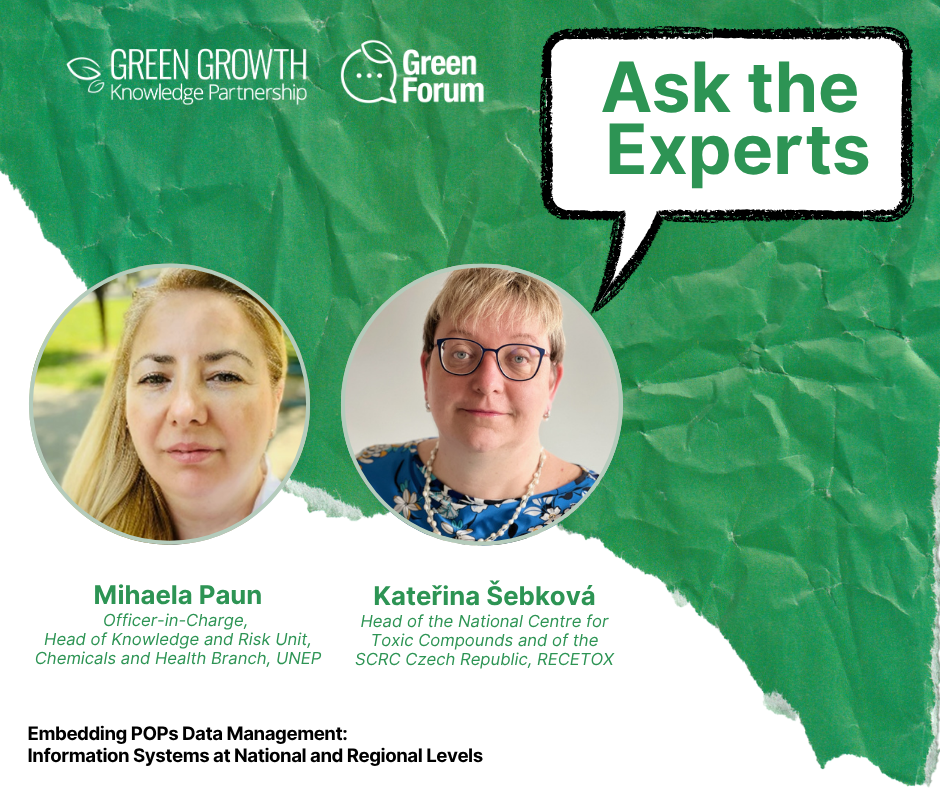
To help address these challenges, Mihaela Paun, Officer-in-Charge, Head of Knowledge and Risk Unit, Chemicals and Health Branch, UNEP and Kateřina Šebková, Head of the National Centre for Toxic Compounds and of the Stockholm Convention Regional Centre (SCRC) in the Czech Republic, RECETOX answered a number of questions raised during a recent GGKP round table “Embedding POPs Data Management: Information Systems at National and Regional Levels” held on 28 October 2025.
Q1: Given the scarcity of financial and human resources at the national level, it can be difficult for countries to implement all data management steps simultaneously. What would be your practical and realistic recommendation — perhaps three key steps — that countries could start with when collecting and managing POPs data?
Mihaela Paun: There is no magic solution, as this very much depends on each country’s context. Before starting data collection, it is crucial to be clear about what data need to be collected and what the main focus is. The chosen collection methods are equally important, as they influence how data will later be stored and aggregated. For example, while some countries may use Excel files, others may have online systems, and these formats need to be compatible. It is also necessary to identify relevant stakeholders early on and build their literacy on how to submit and collect data in a way that matches the chosen formats.
Before launching the process, countries should coordinate internally with teams working under related conventions such as the United Nations Framework Convention on Climate Change or Minamata Convention, since the same stakeholders might already be approached for similar information. This helps avoid duplication and ensures harmonized data formats, making aggregation and presentation much easier.
Q2: Is UNEP analyzing trends of POPs by region, and are there data that relate concentrations to health or environmental impacts?
Mihaela Paun: This work has been primarily addressed through the Global Monitoring Plan related projects and currently continues to be supported via the Global Chemicals Management Programme implemented by UNEP, all financed by the Global Environment Facility (GEF). UNEP has supported the POPs monitoring-related activities, while Secretariat of the Basel, Rotterdam and Stockholm Conventions and RECETOX has played a key role in maintaining the data warehouse.
Q3: From an enforcement and regulatory perspective, the challenge is often translating data into actionable intelligence. Could you elaborate on the data fields and reporting mechanisms designed to identify compliance gaps or non-compliant facilities?
Mihaela Paun: The way data are used depends on the initial request and the policy context in which it is collected. Under the Stockholm Convention, national legislation often establishes mandatory reporting requirements to enable data-based decision making. Policymakers can then use this information to identify trends and take further regulatory action when emissions or concentrations do not decrease as expected.
Data may also be used to document environmental investments or to understand baseline conditions before interventions. Each country will have its own approach, but ultimately, all data collection efforts aim to support the protection of human health and the environment.
Q4: One of the main challenges is obtaining accurate data and ensuring transparency once data are collected from stakeholders. What should countries do in such situations?
Mihaela Paun: A little information is better than none. Accuracy is always a challenge, but it is important to ensure data quality to the extent possible. Often, authorities rely on declarations from stakeholders, which cannot always be independently verified. While it is not realistic to double-check every statement, expert judgment should be used when something appears inconsistent.
Countries can describe such uncertainties in their NIP or inventory reports and revisit them in future updates. Data verification can be resource-intensive, both financially and technically, so it is a matter of national decision how far verification can go. Reporting stakeholders should also be accountable for their submissions, and in some cases, third-party certification — such as requiring evidence for lead-free paints — can help ensure compliance and accuracy.
Q5: Will the tool also cover uPOPs? Is there a plan to assist countries generate the data?
Mihaela Paun: The Stockholm Convention Integrated Electronic Toolkit has templates for uPOPs data storage. However, the data generation implies collecting activity data from industry and making estimations of emissions using the latest version of the Toolkit for Identification and Quantification of Releases of Dioxins, Furans and Other Unintentional POPs under Article 5 of the Stockholm Convention.
Q6: Our country contacted a lot of enterprises requesting information on POPs but received no responses. What would you recommend?
Mihaela Paun: It needs to think outside the box and identify what other actions can be taken to help in getting feedback. Consider awareness-raising campaigns, training sessions organized through industry associations that can cascade information to different industry stakeholders, or simplifying data collection questionnaires to make participation easier.
Q7: A key challenge is not just building a new system but ensuring it works with the existing digital infrastructure. Based on your experience, what was your most significant challenge in achieving interoperability between the new POPs information system and other preexisting national databases (e.g., customs, industrial facility registries), and what was the key to overcoming it?
Mihaela Paun: If there is a system in place, then there is less flexibility. What I would advise is to have an in-depth analysis of what exists and try to play around for POPs data needs and maybe propose limited changes to address your needs as well — it may not be fully comprehensive at the beginning, but it may evolve with time.
Q8: What is the procedure or first step for a country to take to establish its monitoring plan?
Kateřina Šebková: I'd suggest starting by reviewing whether there is any existing legislation that requires monitoring of chemicals in the environment — such as pesticides or released gases and aerosols — and identifying which institution manages sample collection. Usually it is under the Ministry of Environment, environmental agency or hydrometeorological institute. There could be also a possibility to join a global, continental or other monitoring scheme (for POPs monitoring, Regional Organization Groups usually know what activities are ongoing in their region, so I’d suggest to contact them to tell you which network operate in your region/continent and then you may wish to see the possibility on how to join nationally.)
Q9: With access to the Global Monitoring Plan (GMP) appearing limited, how can we capitalize on its data?
Kateřina Šebková: Access to the GMP Data is not limited because any data reported to regional organization groups and used in regional reports are publicly accessible 24/7 once approved by GMP experts. Countries can identify the data relevant to their region and contact regional group members or the GMP Data Warehouse team for assistance. The Czech Republic’s national system, GENASIS, can also help countries with their own monitoring data. If countries contact us, we can allow them to use the system as Canada and Slovakia currently do (and they have a password protected access to their raw data). Countries participating in the Global Monitoring Plan can use the GMP Data Warehouse platform to generate maps or trends for their NIPs and country reports. Alternatively, they can use data from neighboring countries as baseline or proxy, especially for air monitoring, for a similar types of sites.
Q10: Could you share examples of how data have been used to address pollution issues in the Czech Republic?
Kateřina Šebková: One case involved detecting high levels of PCBs near a former factory that produced these chemicals (HCHs and PeCB), which led to remediation activities. Another example occurred at a historic theatre in Český Krumlov, where pentachlorophenol had been used to protect centuries-old wooden beams. The concentrations were significant, posing risks to visitors. Once detected, remediation was carried out in close coordination with archaeological and historical heritage authorities to remove the contaminated material while preserving the site. The levels have since been reduced to safe values, and the theatre is once again in use.
In a few other cases, we discovered contaminated sites in remote areas, prompting further steps or remediation plans.
Water monitoring can be more complex due to flow dynamics, but even there, findings can indicate upstream pollution and make us taking action. Monitoring actives are complex and costly but can trigger immediate action or set up long term plans.
Authors:
 |
Ms. Mihaela Claudia Paun, Officer-in-Charge, Head of Knowledge and Risk Unit, Chemicals and Health Branch, UNEP |
 |
Dr. Kateřina Šebková, Head of the National Centre for Toxic Compounds and of the Stockholm Convention Regional Centre (SCRC) in the Czech Republic, RECETOX |