
Adaptation and Resilience
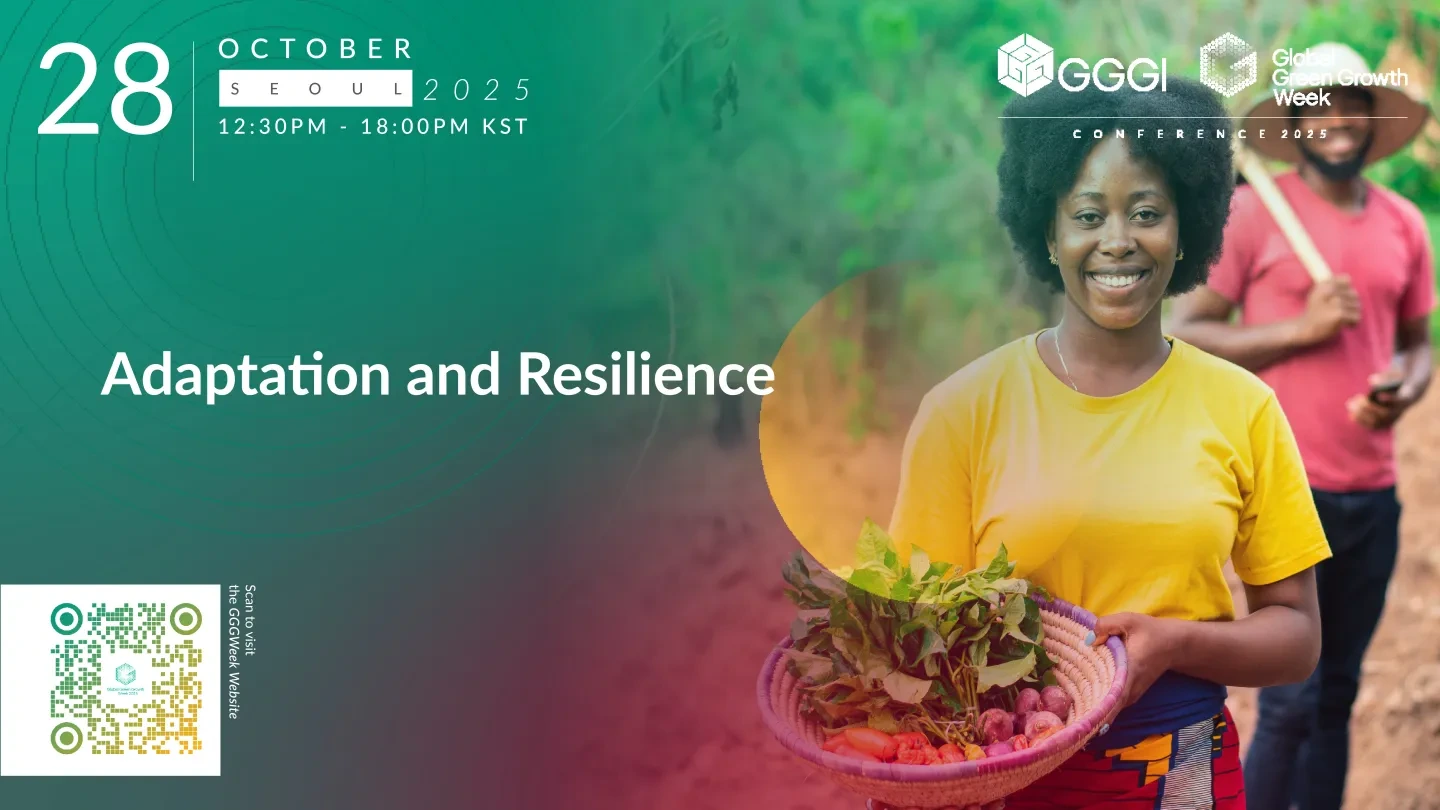
This half-day track brings together a series of interlinked sessions focused on accelerating climate adaptation and resilience for GGGI’s members. From nature-based solutions and food systems resilience to tackling desertification and new financing tools like the SAFA Facility, the program highlights practical and scalable approaches to building climate-ready communities and ecosystems. By clustering these sessions under one overarching program, we aim to connect the dots between local innovations, policy frameworks, and investment opportunities—framing adaptation not as a siloed issue, but as a foundation for sustainable development and climate action.
1. Scaling Nature-based Solutions and Climate Change Adaptation through from Planning to Financing
This session highlights GGGI's role in advancing climate adaptation through nature-based solutions (NbS) and transforming National Adaptation Plans (NAPs) into frameworks for mobilizing finance. Drawing from implementation across coastal, urban, and agricultural systems, the session showcases NbS approaches for risk reduction, ecosystem restoration, and climate-smart livelihoods. It will also share lessons from GGGI-supported NAP processes in Samoa, Angola, and Sri Lanka, where adaptation priorities are being integrated into national budgeting and investment strategies to unlock climate finance. Additionally, participants will hear from strategic partners on the future of NbS and adaptation planning, including the role of AI, remote sensing, and digital tools in enhancing project design and scalability.
2. Community Resilience & Food Security and Food Systems
In Africa, the Comprehensive Africa Agriculture Development Programme (CAADP) constitutes the umbrella under which many initiatives at continental, regional or national level have been aligned.
Food needs are expected to increase, especially between 2050 and 2100, and to produce sufficient food, cultivated areas would need to triple, which is not realistic. Another way to achieve these targets would be to combine cultivated areas extension with increased productivity, which requires heavy investment in innovative solutions. ME-Africa SAFE initiative aims at promoting well-targeted investments in agriculture by identifying the major agricultural products and their value chains most in need of investment, as well as the investors.
A coordinated approach, including women and youth, to making agriculture and broader rural communities more resilient might include strategic investment in climate resilience agriculture (including through irrigation, seed varieties and digital advisory services, plus other targeted climate-smart agriculture technologies and practices) and more profitable (including through scaling-up production and better integration with supply-chains). Getting the fundamentals right – evidence-based land management and planning, secure land tenure and effective broader governance – is needed to deliver this.
The Initiative will rely not only on technological innovations, but will also use GGGI supporting institutional, policy, and investment environments, to ensure innovations reach scale rapidly. It will bolster fit-for-purpose business and financial models to support the scaling up of proven technological innovations. The initiative will promote the systematic preference for sustainable agricultural systems from a socio-economic perspective (use of labor) and also from an environmental perspective (limited use of high-carbon inputs).
3. Green growth as a response to desertification: economic and financing strategies in arid contexts
Many of the world’s deserts are expanding due to climate change as well as overutilization of land and water resources. For the governments and populations of countries affected, this development comes with challenges in terms of local green growth patterns and climate resilience. Often, the number of viable economic sectors is limited and infrastructure services come with high investment requirements. This session emphasizes approaches to green finance in arid contexts and builds on experiences of green growth activities against desertification.
4. Adaptation Planning and the Scaling of Adaptation Finance (including the launch of the SAFA Facility)
This high-level launch marks the unveiling of the Scaling and Accelerating Financing for Adaptation (SAFA) Facility, a global initiative as the fruit of more than one year’s concerted collaboration between GGGI and the Adaptation Fund and a series of dialogues from New York Climate Week to London Climate Week, and which represents a critical approach in addressing the persistent adaptation finance gap by building on and enhancing existing global efforts.
SAFA, composed of SAFA-R (a project preparation facility) and SAFA-F (a Special Purpose Vehicle), creates a “conveyor belt” for adaptation projects by replicating successful models, embedding AI and climate technologies into project design, integrating innovative financial mechanisms and instruments, and leveraging a wider pool of risk-sensitive investors — all aimed at ensuring the long-term sustainability of adaptation efforts. SAFA will serve as a dedicated “one-stop solution” for climate adaptation, benefiting LDCs, SIDS, and MICs.
The event will convene experts from GGGI, Adaptation Fund, and others to unveil SAFA’s vision, project model, and pathways for global collaboration. Attendees will gain insights into how SAFA, as an innovative facility, will catalyze transformative adaptation projects and finance globally. The event will conclude with an official launch and a signing ceremony.