
Measuring What Matters: Tools for Tracking and Accelerating the Green Growth Transition
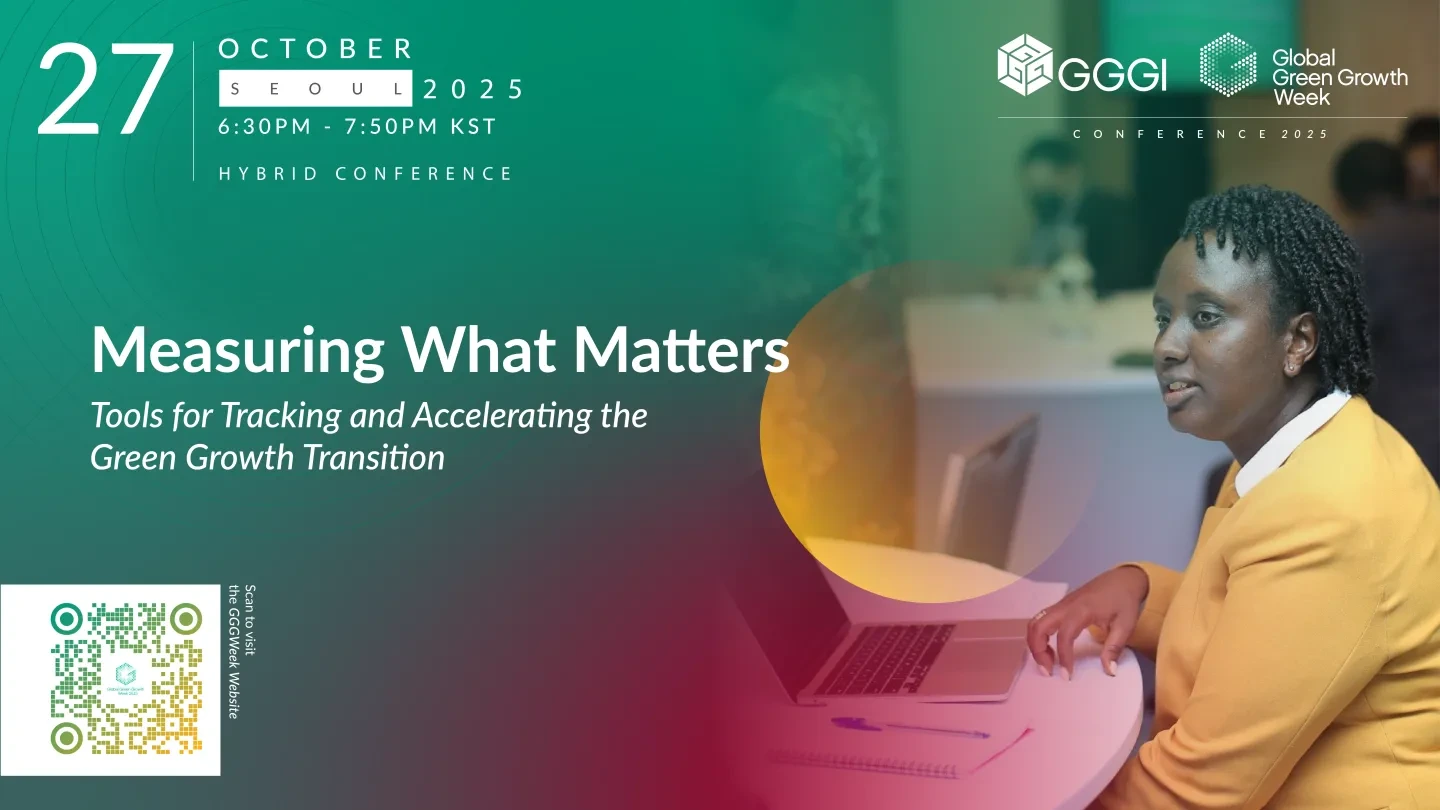
A successful green transition depends on measuring performance and progress with precision, identifying gaps, and translating insights into targeted action. The first part of this session will present new and complementary frameworks for measuring green growth, giving governments, investors, and stakeholders the evidence they need to design and track effective transition strategies. The OECD’s updated Green Growth Indicators, GGGI’s enhanced Global Green Growth Index, and the European Commission’s Joint Research Centre will showcase how robust measurement can accelerate impact.
The OECD will present its updated Green Growth Indicators, applying an environmental lens to long-term drivers of productivity, competitiveness, inclusiveness, and resilience. They quantify the ‘greening’ of labour markets, education systems, consumption and production patterns, investment flows, financial markets, productivity, and public policy, covering more than 50 countries. Taken together, these indicator groups support a comprehensive and coherent assessment of how countries are transitioning to a greener economy. This measurement approach helps policymakers identify trade-offs, synergies, and opportunities for action, supporting effective decision-making across priority areas of the transition. GGGI will present the enhanced Global Green Growth Index, which measures performance in four dimensions: efficient and sustainable resource use, natural capital protection, green economic opportunities, and social inclusion. Methodological advances, including AI, now enable the Index to assess past and current performance, green growth potential, and forward-looking projections for over 150 countries. These tools provide a comprehensive, forward-looking evidence base for strategic decision-making and investment planning.
The Joint Research Centre of the European Commission, through its Competence Centre on Composite Indicators and Scoreboards, will share best practices for developing robust composite indices and scoreboards. Drawing on the internationally recognized Handbook on Constructing Composite Indicators, co-authored with the OECD, it will show how strong conceptual design, rigorous statistical assessment, and transparent reporting enhance the credibility and policy relevance of measurement tools. Its experience in statistical audits is directly relevant to strengthening both the OECD’s Green Growth Indicators and GGGI’s Global Green Growth Index for tracking the green transition and supporting the OECD’s work on using the Pollutant Release and Transfer Register for SDG analysis.
The second part of the session will focus on strategic foresight through a discussion on how green growth outlooks are being developed and applied as forecasting tools to guide low-carbon development and the green energy transition. Drawing on practical modeling experiences, it will illustrate how such outlooks can help countries, regions, and global actors anticipate pathways, assess trade-offs, and identify opportunities for green development. Presenters will also discuss the usability of these tools for decision-makers, highlighting both the challenges and opportunities in translating modeling into policy action.
Building on these examples, GGGI will share its approach to supporting member countries in designing low-carbon and climate-resilient pathways, and explain how these efforts are expanding to the regional level. A key theme will be how dashboards and indicators oriented towards progress assessment are evolving into dynamic and forward-looking instruments for strategic foresight. This shift transforms static data into actionable insights, enabling governments and stakeholders to make credible, evidence-based decisions that can guide global and regional green growth and climate action in the future.