Financing Agrochemical Reduction and Management (FARM)

A post is already pinned to this stream. Would you like to replace it?
GEF FARM

Driven by evolving global standards, regulatory developments, and growing expectations from buyers and consumers alike, a growing number of food producers, retailers, and certification bodies are rethinking how they source, label, and sell products with a focus on how agrochemicals are used… Read More

GEF FARM

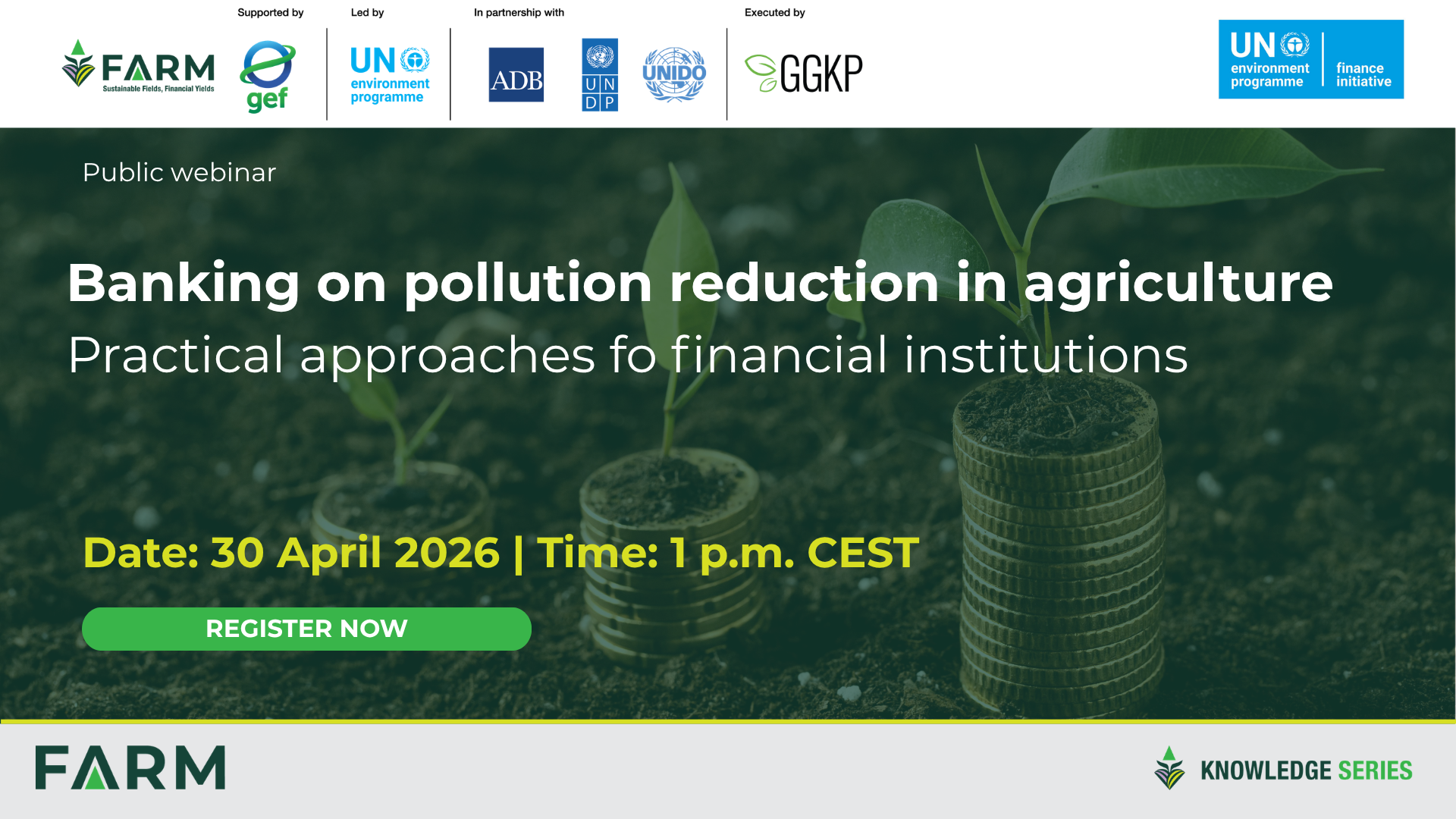
This session is facilitated by UNEP FI as part of the GEF-funded Financing Agrochemical Reduction and Management (FARM) Programme. Informed by the Guidance on Pollution Reduction and Management in the Agriculture sector, the session will facilitate financial institutions,… Read More
European Weed Research Society

This upcoming webinar on "Bioherbicides: Applications, Prospects, and Limitations" may be of interest.One thing that partners (especially in the private sector) often ask for is recommendations for alternatives to herbicides such as glufosinate ammonium, glyphosate, etc. Meanwhile, many of the… Read More

📢 We’re hiring!The Green Growth Knowledge Partnership (GGKP) is seeking a Private Sector Value Chains Specialist to support the establishment of a value chain-based facilitation mechanism designed to strengthen suppliers and retailers’ capacity to implement sustainability actions that align with… Read More

Green Growth Knowledge Partnership(GGKP), United Nations Environment Programme(UNEP)

  This webinar, under the FARM Knowledge Series, brings together national regulators, customs authorities, industry representatives, and international organizations to examine practical experiences in combating illegal and counterfeit pesticides. The discussion explores enforcement… Read More

🎥 Tune in live and join the conversation as leading experts unpack the challenges, implications, and solutions surrounding a critical issue in pest management.

Don’t miss the next edition of the FARM Knowledge Series, where we explore a topic that could undermine regulatory systems, disrupt legitimate markets, and hinder progress toward safer and more sustainable pest management.

This webinar hosted under under the FARM Knowledge Series brings together national regulators, customs authorities, industry representatives, and international organizations to examine practical experiences in combating illegal and counterfeit pesticides. It will explore enforcement approaches, cross-border cooperation, industry collaboration, and multilateral tools that can strengthen national systems.


Illegal and counterfeit pesticides are a serious problem in many countries. These products may be smuggled, fake, unregistered, or falsely labelled. They often bypass safety checks and quality controls. As a result, they can harm farmers’ health, damage crops, contaminate soil and water, and reduce trust.

This session will address how: 

• National challenges countries face in combating illegal and counterfeit pesticides.

• The role of cross-border cooperation and customs enforcement in reducing illegal trade. 

• How industry and regulators can work together to protect supply chains

• The place of international frameworks in supporting national enforcement efforts.

 • Practical steps to strengthen the monitoring and management of illegal pesticides.

Read More

https://youtu.be/rp6lDQYI5Lc
Green Growth Knowledge Partnership(GGKP)

📢 You are invited to the next edition of the FARM Knowledge Series, discussing a topic that has the potential to undermine regulatory systems, legitimate markets, and efforts to promote safer and more sustainable pest management.Don’t miss the next edition of the FARM Knowledge Series, where we… Read More

📢 You are invited to the next edition of the FARM Knowledge Series, discussing a topic that has the potential to undermine regulatory systems, legitimate markets, and efforts to promote safer and more sustainable pest management. 

This webinar hosted under under the FARM Knowledge Series brings together national regulators, customs authorities, industry representatives, and international organizations to examine practical experiences in combating illegal and counterfeit pesticides. It will explore enforcement approaches, cross-border cooperation, industry collaboration, and multilateral tools that can strengthen national systems.


Illegal and counterfeit pesticides are a serious problem in many countries. These products may be smuggled, fake, unregistered, or falsely labelled. They often bypass safety checks and quality controls. As a result, they can harm farmers’ health, damage crops, contaminate soil and water, and reduce trust.

This session will address how: 

• National challenges countries face in combating illegal and counterfeit pesticides.

• The role of cross-border cooperation and customs enforcement in reducing illegal trade. 

• How industry and regulators can work together to protect supply chains

• The place of international frameworks in supporting national enforcement efforts.

 • Practical steps to strengthen the monitoring and management of illegal pesticides.

Register now!

Read More

https://zoom.us/webinar/register/WN_dAp6GsEjSduJn_PTJHudBw

Bridging knowledge and application - Leading a new generation

We are advancing the world’s first Technical Vocational Education and Training (as quoted by GGGI) program dedicated to biochar. As part of the process toward approval by the nation’s educational authority, we conducted a pilot training from 2 to 6 March with 24 participants representing colleges, community members, and government officials. The pilot serves as a key validation step prior to formal approval and national rollout.

We are also continuing our Biochar Study Tours. Pioneering the first in the Philippines, the fourth tour was held in Palayan on 26 February with 68 participants from cooperatives, garnering communities, and both small and large farmers. The tour demonstrated biochar production, application, and field-level impact, with external users reporting reduced chemical and water inputs, higher yields, and improved crop quality. 

Read More

https://drive.google.com/file/d/1jI6YysY7XP7QWOJf_AIrAGk-_AWqI7zb/view?usp=sharing

A very insightful article here from AgFunderNews.com.

"In food and ag, incumbent companies hold the keys. They own the distribution channels, the regulatory muscle, and the customer relationships. If you want to scale, you have to go through them. Inside that reality, most corporations are behaving exactly as their incentives tell them to: protect the core business, avoid surprises, outsource risk. "

"We behave as if our current model of the world – synthetic chemistry, commodity exports, abundant fossil energy, relatively stable trading systems – will hold, perhaps with some ESG tweaks around the edges. When black swans ......., show up. We respond by trimming risk, not by upgrading the system’s ability to adapt."

"Militaries invest in redundant systems, simulation, intelligence, and scenario planning so they can absorb surprises and come out smarter on the other side. Volatility is treated as a reason to add capabilities, not cut them." 

Read More

https://agfundernews.com/how-to-stop-playing-the-old-game-in-ag-innovation